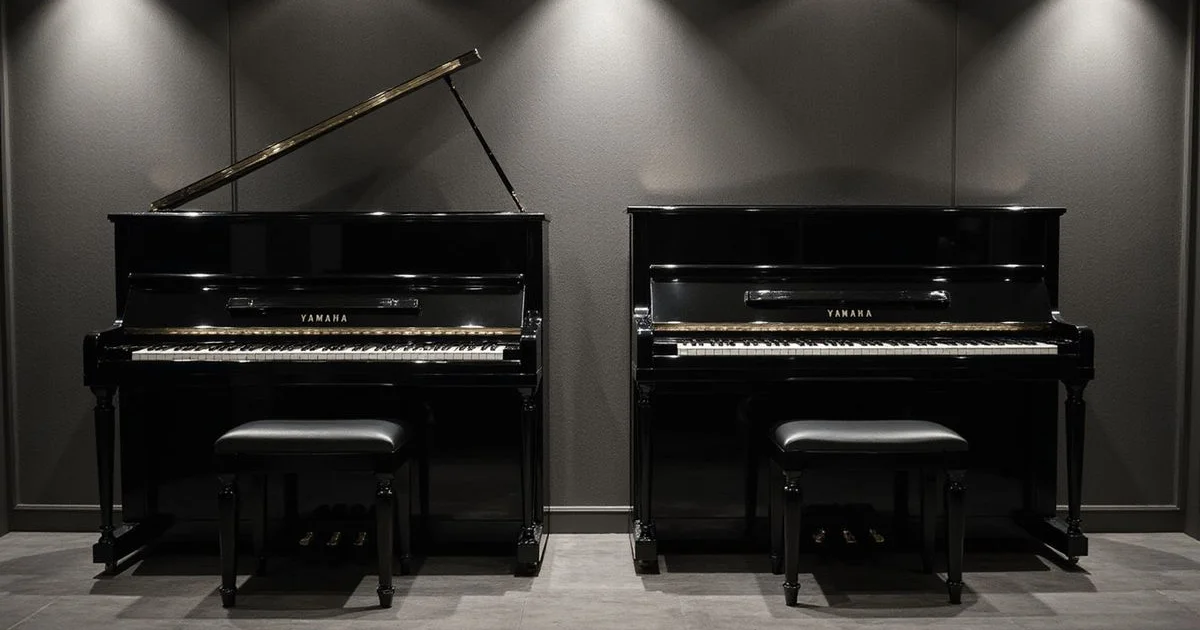
Two Benchmark Secondhand Uprights
You have likely noticed that anyone researching secondhand instruments immediately runs into the classic yamaha u1 vs u3 debate.
We hear this yamaha upright comparison discussed constantly by piano teachers, studio owners, and families. The truth is that both models offer exceptional build quality and hold their value beautifully over decades. The real dividing line comes down to exactly how you plan to use the instrument and the acoustics of your specific room.
Our focus is always on matching the right piano to the right space. You will find prepared Yamaha uprights within our pre-owned and restored pianos. Let us look closely at the data, what the measurements actually tell us, and then explore practical ways to decide which model belongs in your home or business.
Cabinet Height and Dimensions
The clearest difference between the two instruments is the physical height of the cabinet. The U3 stands taller than the U1 by roughly ten centimetres, giving it a more imposing presence in a room. Both have a nearly identical footprint on the floor, meaning they take up the same amount of space against a wall.
If you are a homeowner trying to plan your room layout, you will be pleased to know both models are exactly 153 centimetres wide. We often remind buyers that the depth difference is minimal. A standard U1 is 61 centimetres deep, while a U3 requires 65 centimetres of depth.
Our installation teams handle these daily, and the weight is something to consider for older properties. A Yamaha U1 weighs in at approximately 228 kilograms.
The larger U3 adds extra mass, tipping the scales at around 235 kilograms. The load is evenly spread across four castors, so standard home flooring supports either model safely.
| Feature | Yamaha U1 | Yamaha U3 |
|---|---|---|
| Cabinet height | 121 cm | 131 cm |
| Cabinet width | 153 cm | 153 cm |
| Cabinet depth | 61 cm | 65 cm |
| Approximate weight | 228 kg | 235 kg |
| Soundboard area | 2,137 square inches | 2,369 square inches |
| Tone | Clear and balanced | Fuller, with more depth |
| Best suited to | Most homes | Larger rooms, more sound |
Soundboard and String Length
That extra cabinet height provides essential room for a larger soundboard and longer bass strings. This internal space is the primary source of the tonal difference between the two models.
The acoustic engine of any piano relies on surface area and string length to amplify the vibrations. Our technicians measure the internal differences carefully:
- Soundboard area: The U3 provides approximately 2,369 square inches of resonant spruce, compared to the U1’s 2,137 square inches.
- Bass string length: The number one bass string inside the U3 measures 47.5 inches long, easily beating the 46.8-inch string in the U1.
The U3 uses this extra physical space to produce a richer, more resonant concert-style bass response. The U1 is by no means lacking in character. It produces a clear, balanced and satisfying tone that works perfectly for daily practice.
Tone and Projection
In practice, the U3 projects a much stronger volume and carries a noticeably fuller body of sound. The U1 produces a clear, even and well-balanced tone that perfectly suits an average-sized living room.
For a business owner outfitting a large restaurant or a pianist who wants real acoustic presence, the U3 holds a genuine advantage. The extra cabinet height also allows Yamaha to install longer keys inside the U3. Our professional pianists appreciate the 40.4-centimetre key depth on the U3, compared to the 37.5-centimetre depth on the U1.
This extra key length provides better mechanical control, creating a physical touch that feels much closer to a grand piano.
Many players actually prefer the U1 at home for smaller spaces. A powerful U3 in a small room can quickly overwhelm the acoustics, making it feel like more piano than the space actually needs.
Bigger is not automatically better
The U3 has the fuller voice, but the right model is the one matched to your room. A U1 in a normal living room is a very happy pairing.
Which Suits Which Home
Choose the U1 if your room is average-sized, you want a clear tone, and you prefer a slightly smaller cabinet. Choose the U3 if you have a larger room, you want the fullest projection an upright can give, and the taller cabinet is no obstacle.
We see current 2026 market prices reflecting these material differences across the UK. A high-quality, fully reconditioned used yamaha u1 typically starts around £3,500 to £4,000. You should expect to pay between £500 and £1,000 more for a comparable U3 model.
Making the Final Choice
To make your decision easier, consider exactly who will be playing the instrument. If you are buying a reliable practice piano for students or children, the U1 is a highly cost-effective and sensible investment.
Professionals and advanced classical players usually gravitate to the U3. The combination of the longer key leverage and the booming bass register makes the higher price tag worthwhile for a demanding repertoire. Both models share the exact same high-grade action components and hard maple pinblocks, guaranteeing decades of reliable service.
Buying Used U1 and U3 Pianos
Both models were built in massive numbers and are famous for durability, making them incredibly reliable secondhand instruments. Condition is absolutely everything when buying used, so you must carefully assess the soundboard, pinblock and action.
Our guide to what to check when buying a used piano covers this process in complete detail. It is always smart to bring a qualified technician to inspect the internal mechanics.
Inspecting for UK Market Suitability
We always advise buyers in Great Britain to verify the origin and history of any used Yamaha. You must be cautious of imported pianos that have not been acclimatised to the damp British weather. Ask your dealer to confirm three vital details before you buy:
- Production era: The U1H and U3H series from the 1970s and 1980s are legendary for their stability.
- Acclimatisation: Ensure the instrument was specifically seasoned for the European climate.
- Component wear: Have a technician check for loose tuning pins or sticking keys caused by humidity damage.
Because our pre-owned stock is individually sourced and carefully prepared, the availability of any particular model changes constantly. If you are after a used yamaha u3 or a U1, get in touch with our team today.
We will gladly tell you what we currently have in stock or invite you to play whichever model is sitting on the showroom floor. Come visit the shop and hear the difference for yourself.
Conclusion on the Yamaha U1 vs U3
Choosing between the Yamaha U1 and the U3 simply depends on your space, your budget, and your musical ambitions. Both models represent the gold standard for upright acoustic pianos.
We hope this yamaha u1 vs u3 comparison has given you the clear, factual data you need to make a confident purchase. If you are ready to find your perfect match, reach out to our team to schedule a viewing and try these remarkable instruments in person.