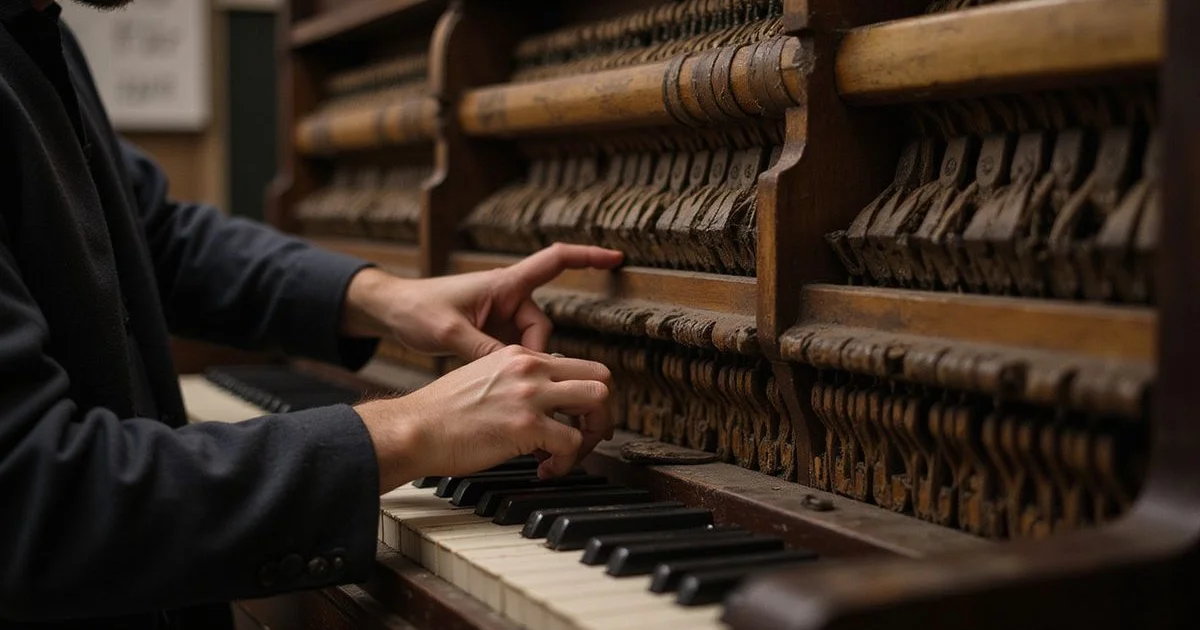
Why Preparation Is the Real Work
We know that buying a piano often focuses heavily on the showroom selection process. The true craftsmanship that makes an instrument a pleasure to play actually happens long before delivery. This guide breaks down exactly what happens to establish how pianos are prepared, making it clear why this hidden labor is so valuable to homeowners and business owners alike.
Our professional service team ensures every single instrument receives the same rigorous attention. Every piano that passes through our doors, whether one of our new pianos or a pre-owned or restored instrument, undergoes a strict workshop protocol.
James, our qualified technician, carries out that work himself.
He acts as both the mechanic preparing the piano and the expert advising you on it. We find this direct relationship keeps the whole process completely honest and straightforward.

The Preparation Workflow
A proper piano workshop workflow follows a strict sequence of inspection, regulation, and voicing to bring an instrument up to concert standard. The process starts by examining the structural integrity of the piano before any mechanical adjustments are made.
We begin with a full inspection of the soundboard, the cast iron frame, the pinblock, and the strings. James forms a clear picture of the condition of these core components first. Only after passing this structural check does the hands-on mechanical work begin.
Mechanical Action Regulation
Regulation is the painstaking job of adjusting the thousands of moving parts within a piano so every key responds evenly. A standard modern piano action contains over 9,000 individual wooden and felt components.
We carefully adjust this mechanism to ensure every single key shares the exact same weight, depth, and repetition speed. A standard key dip in the UK is precisely set around 9.5mm to 10mm. Proper regulation marks the difference between a piano that feels alive under the fingers and one that feels sluggish.
Key regulation adjustments include:
- Let-off alignment: Setting hammers to release fractions of an inch before striking the string.
- Key leveling: Ensuring the keyboard sits perfectly flat across all 88 notes.
- Repetition spring tension: Tuning the springs so notes can be repeated rapidly without sticking.
- Hammer travel: Aligning parts so hammers strike strings at a perfect 90-degree angle.
Piano Regulation and Voicing
Piano regulation and voicing directly follow the initial mechanical adjustments. This combined process shapes both the physical feel and the acoustic profile of the instrument.
Our technician uses specialized voicing needles to carefully prick the compressed wool felt of each hammer. Modifying the tension of the felt alters the tone, ensuring an even sound from the lowest copper bass strings to the highest steel treble wires.
James manually adjusts the hammer shape so there are no harsh, overly bright notes or dull, muted ones. Voicing is precisely where a piano gains its unique musical character.
We consider this the most artistic part of the entire workflow. A poorly voiced piano will quickly frustrate a serious student or performer.
The point of preparation
A prepared piano is not simply a piece of furniture that produces sound. It is a finely tuned machine optimized to play evenly and reliably across every note.
Tuning and Final Checks
The final stage of piano preparation involves pulling all strings to standard pitch and performing rigorous safety inspections. Once the action and tone are correct, the piano is tuned precisely to concert pitch, A440.
We bring the instrument to this standard frequency so it matches perfectly with other instruments and recorded music. A standard acoustic piano holds roughly 18 to 20 tons of combined string tension across its cast iron frame. Reaching stable pitch requires multiple passes by the tuner.
Before any piano leaves the workshop, James carries out a last comprehensive set of structural and safety checks. Every single moving exterior part is tested for smooth operation and durability.
Our final inspection covers the heavy brass castors, the pedal trapwork, the lid hinges, and the protective fallboard. The instrument is then declared ready for dispatch.
Delivery teams place and settle the piano securely in your specific room. UK homes experience significant seasonal humidity fluctuations, so wait for the wood to acclimate. We highly recommend scheduling a follow-up tuning approximately four to six weeks after delivery.
| Component | Inspection Standard | Corrective Action if Failed |
|---|---|---|
| Pedals | Smooth, silent engagement with no squeaks. | Lubricate trapwork and adjust springs. |
| Fallboard | Safe, controlled closure to protect fingers. | Adjust hinge friction and alignment. |
| Castors | Free movement under the 200kg+ cabinet weight. | Clean and lubricate brass housing. |
| Pitch | Stable A440 frequency across all 88 notes. | Perform secondary pitch raise. |
New and Pre-Owned, the Same Standard
Every piano demands comprehensive workshop preparation regardless of its age or previous ownership history. It would be easy to assume a brand-new, factory-fresh piano needs no preparation whatsoever. The reality is quite the opposite.
Even a newly built instrument requires full regulation, voicing, and a concert pitch tuning once it settles after international transport. We treat a new piano with the same mechanical scrutiny as a vintage piece.
A pre-owned or restored piano naturally demands more labor-intensive interventions to reach its full potential. Worn felt parts often require complete replacement to restore original tolerances.
Our technician brings the action back into perfect regulation and restores the lost tone. The required workload increases, but the final performance goal remains absolutely identical.
Whatever its specific history, a piano only leaves the workshop when prepared to an exacting standard. Buyers can confidently purchase a pre-owned instrument knowing it plays just as beautifully as a new one — a reassuring point if you are still weighing up new versus pre-owned pianos.
Preparation differences based on instrument age typically include:
- New Pianos: Focus is on stabilizing tension, initial voicing, and correcting minor shipping disruptions.
- Pre-Owned Pianos: Focus involves reshaping worn hammers, replacing compressed felts, and deeper regulation adjustments.
What This Means for You as a Buyer
Purchasing a professionally prepared piano removes the mechanical guesswork and guarantees an instrument ready for immediate play. You are never left hoping the cabinet will magically settle or wondering what expensive repairs it might suddenly need.
The piano has already been fully assessed, corrected, and tuned by an expert who understands complex acoustics deeply. We essentially save you the £300 to £500 that an immediate post-delivery technician visit would typically cost in the UK.
This thorough preparation represents the quiet, hidden value behind every single instrument sitting in our Harrogate showroom. A fully optimized piano responds faster, sounds richer, and actively encourages a player to practice longer.
Key benefits of buying a prepared instrument include:
- Immediate Playability: No waiting for weeks of mechanical settling.
- Financial Savings: Avoiding initial workshop correction fees.
- Musical Consistency: Reliable touch weight across all registers.
Our team always encourages local homeowners and business managers to visit in person and play the keys. A properly prepared piano reveals its true character the very moment you sit down on the bench.
The absolute easiest way to understand the dramatic difference this preparation makes is to feel the responsive action for yourself. We invite you to contact the Harrogate showroom today to schedule a viewing and test an instrument in person.